Freedom / Vulnerability, a marriage ceremony in the English Reformed Church, Begijnhof, Amsterdam
How to document a miracle? This is what I asked myself after the wedding ceremony was over and 6 months of almost continuously working on it had ended. The ceremony took place in a church in Amsterdam's Begijnhof, where in 1345 a miracle had taken place. The convent is located behind Spui square and was a place that once once was a safe haven for free women who voluntarily devoted themselves to religion. Now it is a pilgrimage for visitors who guided by their travel visit the last quiet place in Amsterdam. What is left of it are two churches and in the English Reformed Church founded in 1607 our service was held. On the cover of the liturgy of the service you could read the title
Freedom / Vulnerability,
Christian van der Kaap,
Marina Elenskaya, May 5, 2012. Is also depicted on a reproduction of a memorial stone or rather a 'gedachte-nis' (literally translates to a niche for thought) of the miracle. A miracle occurs only to those who are witnessing it. They in turn give testimony to it by leaving some of their experience behind. This appeared to be a nice place to put it. On other occasions of miracles, people deposited flowers. This is precisely the reason why, if at all, the marriage can be seen as the miracle. The role of the witnesses, and I mean not only the best men but of the whole community, is crucial. How special is it when people voluntarily promise to be part of the intimate bond between to people?
This question gave form to the service to which people in our surrounding contributed. After everyone had come together in silence on the square in front of the church, the ceremony commenced with the sign of a a flag carried in front of the minister and bride and groom. This flag was the
Flag of Compassion, part of one of the contributions to our service. A white flag with a gold waved band was held by
Raphael Langmair and
Elsbeth Ciesluk as representatives of an unknown country. Their action was all the more meaningful by the fact it replaced the flag of the United Kingdom for the duration of the ceremony. As if everything it had represented in its course of history for the moment hadn't occurred. Apart from that, people weren't surprised by a flag being risen. After all it was the 5th of May, the day when in the Netherlands we raise our flags to remember that we were ever freed ourselves. A flag marks as a place, like the memorial, so people can stand to think about .. perhaps a miracle?
It was also during the arrival of the flag, the pastor and the bride and groom that music was played.
Rory Pilgrim composed two pieces for the service for the organ, one for the entry titled 'Care' and 'Together' played when leaving the church. Both words and music collected the ceremony. In a way just like the guests, the minister and the participants, and all witnessing the ceremony were collecting. Then it slowly became religious. As if the actuality of the event was not yet entirely clear, an approaching change was announced. My brothers
Leon and Alain van der Kaap sang 'A Change is Gonna Come' a song by Sam Cooke. More than a harbinger of something to come, it was an appeal to the whole of the community and to their brother. As if the promise we make to each other would also be promise to any one of them. The definition that marriage serves a common interest is absent to me.
Then we sang together. 'This is God's House'. A song written by John Bell in honor of the church, offering time and housing memory. Singing about the place we found ourselves in, gives room for though. On the back page of the liturgy book we each wrote our doubts about marriage. With the sentence 'Things you do, and do not understand' I wanted to share the incredibly uncertainty of marriage, that I was about to confirm. At the moment it actually happened It was of key importance you were clearly understood. Whatever one had to say it had to be wholeheartedly. That was when the marriage vows were spoken. Subsequently, we promised each other something maybe nobody else needed / wanted or was able to hear. It was about the freedom and vulnerability of our person. After which it was understood that we belong together. Whereupon it was suddenly clear why everyone was present.
Why it is so unusual that men and women belong together would become clear from a story and the drawings of
Isfrid Angard Siljehaug. She told about Androgynus who gave testimony to this discomfort. Once a double-person, man-woman, his fate had let him to be cut in half by God. It remained unclear whether he was cloven by doubt or fear. But clearly, a mystery was needed to put all the events preceding this moment into perspective.
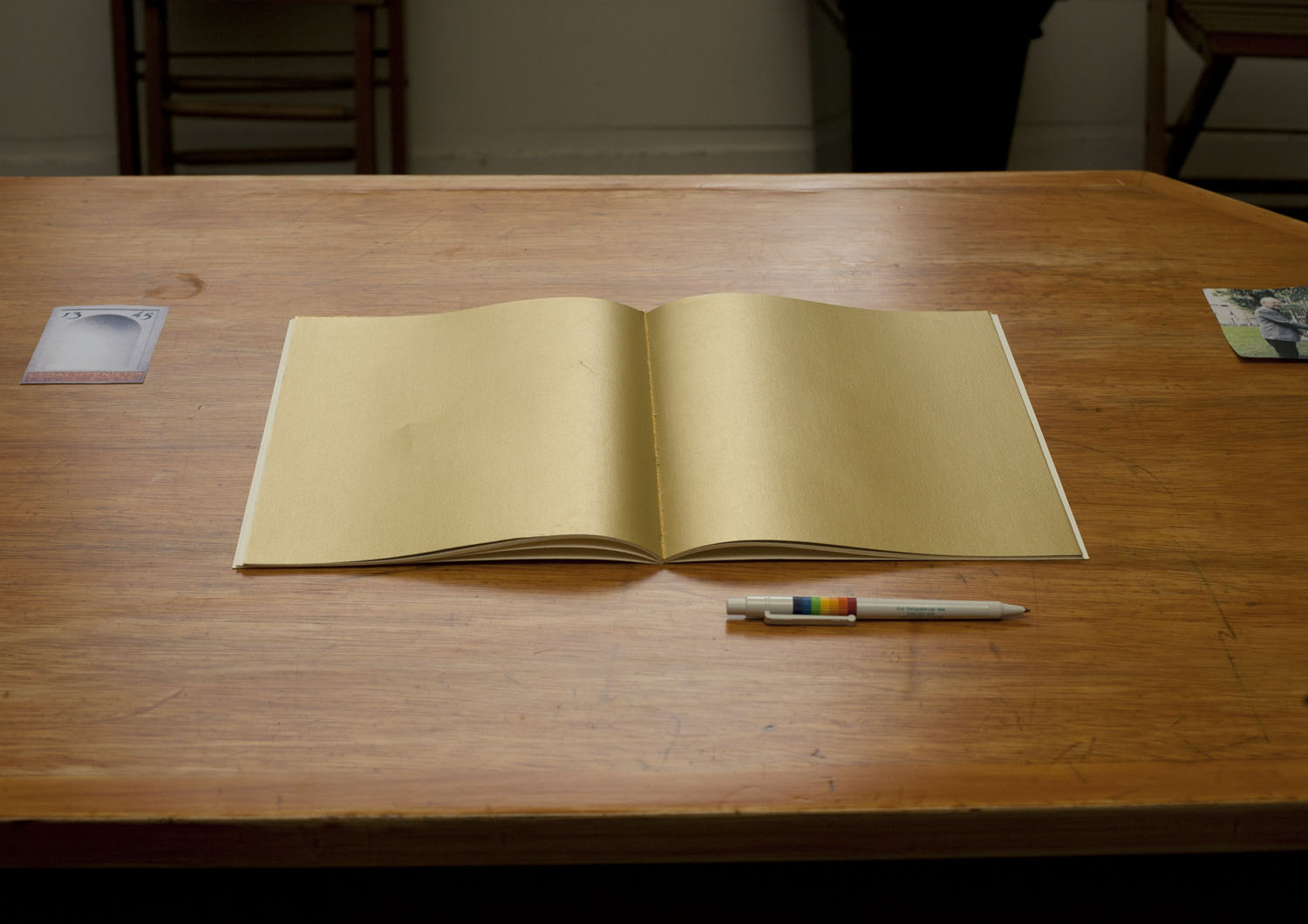
Everyone looked at each other when the minister had thanked and given his blessing to the community. Reinforced by the silence everyone gathered outside of the church. Before and after the ceremony a photograph was taken of everyone who was a witness to the event. People could write their testimony in a golden book that was laying of a table in the reception area. We were left without a really clear ending. Although we had to pack everything except the flowers that were stuck in the pews. At 12:30, an hour after the ceremony had started we found ourselves outside again. A day before we took a solemn two minutes of silence for the fallen soldiers of a war we all didn't experience. I wonder if it was the same silence. Because then we will have to do it again next year.
view liturgy