Thursday, April 11, 2013

Best of Times I & II


with special thanks to Dagbladhandel Sonia Patteet, Antwerpen

Thursday, April 4, 2013

I shall be rereleased, 2013


It's the first time me and my wife were asked to participate in a group exhibition together. Since we both represent different trades, she being a contemporary jeweler and me, a fine artist, we crossed each while in both making our own magazine about our experience and dialogues with people in our fields.

For the exhibition we both showed our own magazines inseparably intertwined, which for us was a statement about our desire to continue using it as our medium. 

Current-Obsession, Magazine for Contemporary Jewellery #1 www.current-obession.com
C.I.N.V.U, magazine about loneliness #1 www.cinvu.nl

The exhibition 'Mariposa' runs from 02/04 til 18/05 in gallery Amaranto Joies, Sant Domènec 23 in Barcelona.

Friday, February 22, 2013

Working in the dark, 2013


Working in the dark. A little investigation into what Antwerp has to offer in terms of production. Photographing (work)shops when they open and close.

Veron bakery, Jybe groceries, R. Berdal & Co tools

Friday, January 25, 2013

Viktualienhaus, 2013


I'll be working with a very special greengrocer in München coming March. I met them about a year ago. It might sounds silly, but the way they presented their exotic fruits and vegetables was very remarkable to me. For me, their love for the produce and the way their goods kind of presented themselves to the customer (like the potatoes on the scales and bananas on the shelves) seemed analogous to the way I imagine a perfect artwork being 'transacted'. The new work (the chosen medium: a functional website) will be made largely with their input. I took this picture when I was there:


Things you do and don't understand, 2013


Interview with Chris van der Kaap (Enschede, 1989)


In your work you frequently make an appeal to others to make your work. Can you tell us why not do it yourself?
Uncertainty, .. fear of overestimating authorship .. One of the things I have difficulty coming to terms with is the fact an artist attends to his own acquired style or language. while at the same time I think I admire those (like craftsmen) who do. The artists that I learn from the most are in fact those who know how to give a voice to others and bring people together. I see a kind of strength in transcending ones own style, but this also requires a strong conviction. In fact, I myself work with others to alleviate the preconceptions I have about a particular way of working or a problem, trying to let go of them completely. I do this through the sharing of my ideas and thoughts with others, which sometimes make it seem like I pass my problems onto them. But that's not really my intention. A good example of this 'conflict' is the work 'SOLO: the maker ain't solonely as before' from 2010. A commission gave me the opportunity to create a work for a special event. At first instance, you are of course glad because you've been given such a chance, but then you suddenly realize how many options there are, or worse, how many expectations are invested in you. The work 'SOLO' was actually a way to undermine that expectation. The work is called 'SOLO' but is really about the fact you can't do it alone. You need others to ultimately show what kind of work you do. I then decided to ask an Italian terra-cotta sculptor to make the work that I was expected to produce. I was looking for someone who wouldn't normally possesses the same freedom that was handed to me when I received the commission. Because I couldn't deal with it. I wrote a very general description of how large the work should be and what material I had in mind but refused to give any instructions about a possible theme or goal. The confidence that I had laid in him would appear from the fact that regardless of the outcome the work, he was to deliver it only at the eve of the exhibition. Because I didn't want to be the one still deciding what the work should mean or be like. The work that resulted from this 'partnership' marks the beginning of my way of working. The result was not only much more than I expected, it was the first time I could see my work as if I was one of the spectators. It came on to me as an act of compassion or even devotion, addressed to a complete stranger.
Does this have to do with a sense of loneliness, a theme that also came forth in your magazine 'C.I.N.V.U'?
The word already surfaced in the title of that work and I've been going about it my own way. But loneliness only really became a standalone theme when I began to feel a kind of responsibility for it. It began with the idea for the magazine. It took off with an open call to anyone who felt addressed by the theme to contribute to this work. All of a sudden, along with many others, I felt the need to give shape to it. The magazine covers many different aspect of my work than those I just described. It required a different line of questioning, about how you design something and for whom it is intended. One of the beautiful things I found out was how this medium (unlike many of my other work) can easily be passed from hand to hand. That somehow made it into a success.
Of what collaboration do you speak the most?
I like to talk about my work and it shows that I am still very selfish. One of those selfish tendencies led me to make the work 'Univocally'. An attempt as an artist to merge into an existing production. I worked with 6 Russian porcelain makers in Krasnodar. A kind of family business that made little hand painted souvenirs for both tourists as well the Russians themselves. My intention as an artist was to become fully involved with an existing production. The title 'Univocally' is a hopeful thought about how different people can work together to create a single product. The title echoed in the shape of the work that we decided to make, namely a bell. Everyone took their own task to make a total of seven bells. One for each maker. I also like to speak about failure. Since this project (because of a great deal or problems) never really reached to the point of completion. I don't know how to deal with that yet.
In what historical context do you place your work? We know of the work of Jeff Koons who lets his work be produced by others. While others may recognize the postmodern melancholic love for crafts, like for example Grayson Perry. Can you say something about this?
I love Perry. But I must say that my relationship with other artists is somewhat loaded. During the academy I completely identified myself with my artistic examples, while at other times I wanted to have nothing to do with them and I educated myself with ignorance which you sometimes need if you want to produce anything at all. I must admit? that the circle of people who inspire me has become quite narrow. Because I notice that when I meet someone special I want to be completely open. I do not want to be busy with James Lee Byars or Bonnie 'Prince' Billy.
Why is the medium in which you work so elusive, sometimes even intangible?
I once made a work for which I needed more than 300 pounds of porcelain. That was very heavy and expensive and I also had no car or license to transport it. Because I have a weak back it was a big burden, but I had it gladly. When I began to work with others, I noticed that I was more concerned with investing in cooperation than in raw material and I felt much better. Not just because we could share the burden but I contributed in a positive way to local production. It's not a shame to spend a lot of money on art and certainly not your own, but I am someone who is very conscious of what he adds in terms of production. It has something to do with responsibility. I prefer to work with the responsibility for others than for 300 pounds of clay.
What is your greatest hope for the future?
A question I could only ask myself. I am married, I have a cat but I'm not (yet) happy. In 2008 a friend of mine, whom I also work for as an artist assistant, composed a beautiful list of things he still wanted to do. There was no time-limit attached. It was a long list of both big things like "falling in love" but also stuff like "learn to crochet and/or knitting". Working as an artist assistant (and good friend) is great to do. You help someone else to realize his work. I hope I am able to stay.
What revolution would you still like to experience?
Since my earliest work, when I spend hours behind the blue screen of WordPerfect 5.1, I'm working on a sort of revolution. I notice that in every work in which I fully surrender a part of that revolution comes about. I do not know if that happens only in myself or of it is going on around me. 'Name 5 things you care about the most?', 'What do want to protect? "," What do you want to survive?". These are three questions composed by Rory Pilgrim (Bristol, 1988) whose work I find very special. If you care to answer these questions, the revolution all of a sudden seems to be a lot closer.

Sunday, December 9, 2012

It's not unusual, 2012


'It's not unusual, 2012' is a performance.

A sentimental and slightly out of place text spoken by the auctioneer during a small art-auction in Zürich. About belonging, about the work we make and spend and how unbelievable it is that one who buys your work inherently wants to take care of it.

Saturday 19:00 15/12/2012
3rd Anonymous Art Auction organized by Gibsmir family. 
You are invited!

Blowup, Albulastrasse 38, Zürich
Switzerland

Sunday, November 4, 2012

For ever and ever, 2012


05/05/12

Half a year ago.

For ever and ever, 2012

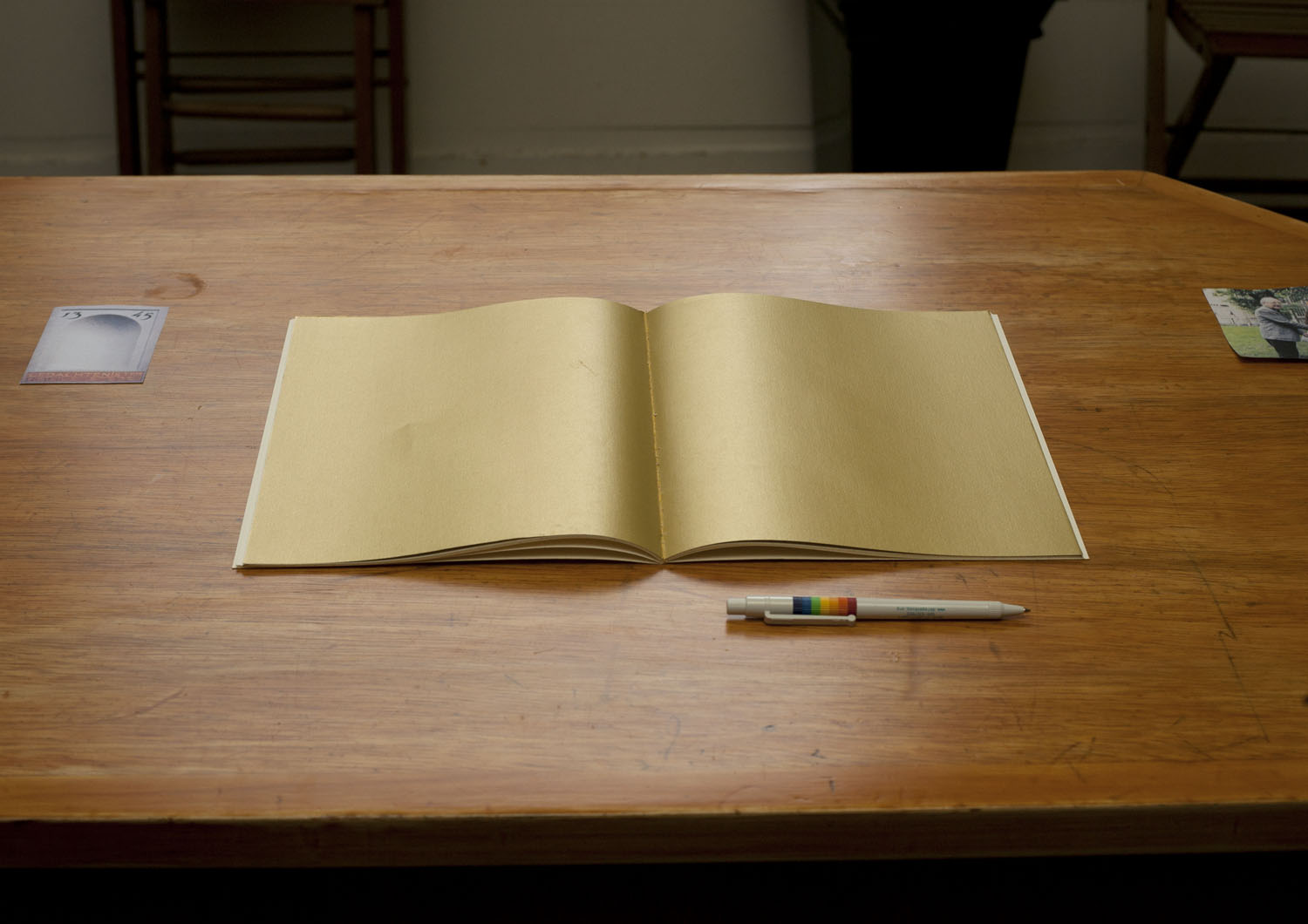
Photos : Thomas Nondh Jansen, Golden reception book : Christian van der Kaap, Sheet music 'Together' : Rory Pilgrim, Drawing 'for ever + ever ME CK': Sands Murray Wassink in 2 oak frames.

Tuesday, October 16, 2012

The Numeration of People, 2012


Under the painting 'The Numeration of the People of Bethlehem' (1566) by Pieter Breughel in Museum Mayer van der Bergh in Antwerp sits a table with two period chairs and a handmade reception book. People inspired by this scene use it to reply to Breughel's signature style in their own handwriting, thereby becoming witness to the historic and biblical event of the numeration of people. The gentle act of putting ones name and observations on the scene in the book, places it into a present day setting.

Saturday, July 28, 2012

Univocally, 2012


1/7 

Univocally. 

In many ways the bells project 'Univocally' is a sequel to the Pietà I 'received' for my first solo exhibition SOLO: the maker ain't so lonely as before in Het Concertgebouw in 2010. It also builts on my interest in ceramics. This series of Russian made porcelain bells is about the precarious relationship between the viewer and the maker. 'Univocally, 2012' is not just another souvenir-styled gift. The title of the project describes my artistic desire to go into an existing production. Univocally is about the different trades within one process, working together to produce a single object, driven by perhaps a single purpose. The word univocally also responds to the sound of a bell, whether or not these seven casts ever will sound in unison. Six of seven sculpted, moulded and cast pieces will be handpainted in the little workshop (in Krasnodar, Russia) in which I have worked and intiated this project, concluding a period of two motnth work, now almost a year ago. The calm and collected voice of all who participated was suddenly threatened, breaking any claimes of my utopic 'artistic' ideals. Divorce, disagreements and a threatening closure of the workshop, all endangered the precarious voice that was to enchant the viewer the moment it was finished. 

Now, almost a year later, the project is finally nearing completion. Revealing more and more of the importance to work together in unison in order to produce the desired outcome. The time it took encompassed lots of changes in the design of the bell and redefinitions of the project. What didn’t change was the title, which appeared, just like the bell, to be a beacon and a form of meditation. Just like 'SOLO' in 2010, the anticipated result of this collected effort may suprise each and everyone of us and might start a whole new story of it's own.

Univocally, 2012 is a project by Gerb95, Krasnodar and Christian van der Kaap with the support of Marina Elenskaya, connecting not only our difference in views but also the stretch in language. 

Friday, June 29, 2012

C.I.N.V.U, 2012


C.I.N.V.U magazine about loneliness, first released the 27th of June 2012.

On Sunday, July 1 at 12:00 pm at Athenaeum Nieuwscentrum on the Spui we will present C.I.N.V.U, a magazine about loneliness. The magazine and its presentation is a work of Christian van der Kaap (1989). For this presentation a large number of participants will attend and you are very welcome to come and witness!

An artwork in the form of a magazine about loneliness, that is C.I.N.V.U (pronounced: See I envy you). It started with an open call asking people to contribute to an 'image' (Dutch: beeld) of loneliness through texts, images, songs and messages of support. Not intended as an argument for or against loneliness, but rather to get an idea what loneliness can show us. The form of the magazine also contributes to that. Showing us the actuality but also our impermanence, a pile of glossy stapled paper reflecting our intrinsic desire.

However the magazine is only truly remarkable because of the countless contributions we received after putting out the call. Artists, photographers, writers, musicians and other makers appeared to grasp it's meaning, almost to the point of taking it for granted. It seems, the chasm of misunderstanding that is so characteristic of loneliness suddenly seemed to be bridged. Like never before showing the strong need to share solitude with everyone else

In this first issue of C.I.N.V.U, people from different generations look backwards and forwards to see what loneliness did or might do to them. Yet the magazine seems inadequate in asking the actual question what is really at stake between its creators and readers. It is this unbridgeable actuality that compels us to ask the same question over and over again. It may be clear that with this single issue the question won't be resolved. The hope, urgency, timeliness and the future of loneliness that arise from the first issue is asking for a sequel.

C.I.N.V.U is a 68 pages full-color glossy, published and distributed with the imprint of Medium by MER Paper Kunsthalle in Ghent. The circulation of the magazine is 2500 and lies in store for € 6.95.

Get the magazine online at: http://www.merpaperkunsthalle.org/projects/view/656

www.cinvu.nl


Thursday, May 10, 2012

Freedom / Vulnerability, 2012

Sands Murray Wassink
Isfrid Angard Siljehaug


Leon van der Kaap
Sterre & Len van der Linden
Flag of Compassion

Christian van der Kaap & Marina Elenskaya
Raphael Langmair & Elsbeth Ciesluk


Isfrid Angard Siljehaug
Iva Supic-Jakovic
Barbara Amalie Skovmand Thomson

Rory Pilgrim


Listen: Rory Pilgrim. Together, 2012
played on organ by Olja Bučo

How to document a miracle?


Freedom / Vulnerability, a marriage ceremony in the English Reformed Church, Begijnhof, Amsterdam  

How to document a miracle? This is what I asked myself after the wedding ceremony was over and 6 months of almost continuously working on it had ended. The ceremony took place in a church in Amsterdam's Begijnhof, where in 1345 a miracle had taken place. The convent is located behind Spui square and was a place that once once was a safe haven for free women who voluntarily devoted themselves to religion. Now it is a pilgrimage for visitors who guided by their travel visit the last quiet place in Amsterdam. What is left of it are two churches and in the English Reformed Church founded in 1607 our service was held. On the cover of the liturgy of the service you could read the title Freedom / Vulnerability, Christian van der Kaap, Marina Elenskaya, May 5, 2012. Is also depicted on a reproduction of a memorial stone or rather a 'gedachte-nis' (literally translates to a niche for thought) of the miracle. A miracle occurs only to those who are witnessing it. They in turn give testimony to it by leaving some of their experience behind. This appeared to be a nice place to put it. On other occasions of miracles, people deposited flowers. This is precisely the reason why, if at all, the marriage can be seen as the miracle. The role of the witnesses, and I mean not only the best men but of the whole community, is crucial. How special is it when people voluntarily promise to be part of the intimate bond between to people?

This question gave form to the service to which people in our surrounding contributed. After everyone had come together in silence on the square in front of the church, the ceremony commenced with the sign of a a flag carried in front of the minister and bride and groom. This flag was the Flag of Compassion, part of one of the contributions to our service. A white flag with a gold waved band was held by Raphael Langmair and Elsbeth Ciesluk as representatives of an unknown country. Their action was all the more meaningful by the fact it replaced the flag of the United Kingdom for the duration of the ceremony. As if everything it had represented in its course of history for the moment hadn't occurred. Apart from that, people weren't surprised by a flag being risen. After all it was the 5th of May, the day when in the Netherlands we raise our flags to remember that we were ever freed ourselves. A flag marks as a place, like the memorial, so people can stand to think about .. perhaps a miracle?

It was also during the arrival of the flag, the pastor and the bride and groom that music was played. Rory Pilgrim composed two pieces for the service for the organ, one for the entry titled 'Care' and 'Together' played when leaving the church. Both words and music collected the ceremony. In a way just like the guests, the minister and the participants, and all witnessing the ceremony were collecting. Then it slowly became religious. As if the actuality of the event was not yet entirely clear, an approaching change was announced. My brothers Leon and Alain van der Kaap sang 'A Change is Gonna Come' a song by Sam Cooke. More than a harbinger of something to come, it was an appeal to the whole of the community and to their brother. As if the promise we make to each other would also be promise to any one of them. The definition that marriage serves a common interest is absent to me. 

Then we sang together. 'This is God's House'. A song written by John Bell in honor of the church, offering time and housing memory. Singing about the place we found ourselves in, gives room for though. On the back page of the liturgy book we each wrote our doubts about marriage. With the sentence 'Things you do, and do not understand' I wanted to share the incredibly uncertainty of marriage, that I was about to confirm. At the moment it actually happened It was of key importance you were clearly understood. Whatever one had to say it had to be wholeheartedly. That was when the marriage vows were spoken. Subsequently, we promised each other something maybe nobody else needed / wanted or was able to hear. It was about the freedom and vulnerability of our person. After which it was understood that we belong together. Whereupon it was suddenly clear why everyone was present.

Why it is so unusual that men and women belong together would become clear from a story and the drawings of Isfrid Angard Siljehaug. She told about Androgynus who gave testimony to this discomfort. Once a double-person, man-woman, his fate had let him to be cut in half by God. It remained unclear whether he was cloven by doubt or fear. But clearly, a mystery was needed to put all the events preceding this moment into perspective.

Everyone looked at each other when the minister had thanked and given his blessing to the community. Reinforced by the silence everyone gathered outside of the church. Before and after the ceremony a photograph was taken of everyone who was a witness to the event. People could write their testimony in a golden book that was laying of a table in the reception area. We were left without a really clear ending. Although we had to pack everything except the flowers that were stuck in the pews. At 12:30, an hour after the ceremony had started we found ourselves outside again. A day before we took a solemn two minutes of silence for the fallen soldiers of a war we all didn't experience. I wonder if it was the same silence. Because then we will have to do it again next year.

view liturgy

Thursday, April 19, 2012

Freedom / Vulnerability, 2012


A marriage between Christian Albert Lucien van der Kaap, born 25.04.2989 in Enschede and Marina Elenskaya, 07/16/1983 born in Krasnodar, Russia in the English Reformed Church of the Begijnhof in Amsterdam 11.00 gather, 11.30 service

Making public that I was going to marry my girlfriend, people in my surrounding responded to telling us they wanted to be a part of it. A strange reaction in our opinion, because isn't marriage usually a bond between two people? Is the public present not merely a witness and apart from that share no active role in this. Why then their spontaneous reaction? I can only say how much I appreciate it and how it has inspired me as an artist to look at what this commitment means. How can our intimate promise inspire a community?

The 5th of may, Dutch liberation day it will be about belonging. Behind the busy Spui square, we will join in the Begijnhof to gather in silence. We let others speak, present and play to help us shape our intimate bond. It’s about freedom and vulnerability.

With: Margriet van der Kooi, Rory Pilgrim, UNDA foundation, Raphael Langmaier, Elsbeth Ciesluk, Isfrid Angard Siljehaug, and others

Thursday, February 23, 2012

C.I.N.V.U | Magazine about loneliness


C.I.N.V.U. [si ay ɛn vi yu]

CALL: There are many magazines focussed on niche markets. Yet there isn't one of them dedicated to loneliness. That's about to change. You can work together with artist Christian van der Kaap to create an artwork in the form of a magazine that wants to show the creative force of loneliness. Do you feel addressed? Visit the website (Dutch only) and send your contribution to: parfumisme@gmail.com and include [C.I.N.V.U] in the subject header.

Monday, February 20, 2012

Supermarket Artfair, Stockholm 2012

The Zoldermuseum presents 'Give a little bit, 2012'
a work in collaboration wit Yeb Wiersma at the
Supermarket Artfair in Stockholm, Sweden


supermarketartfair 2012
zoldermuseum

Thursday, January 26, 2012

Univocally, 2012

Univocally, the project we are working on hard to complete just got sponsored by the Materiaalfonds and Stichting Stokroos.